
Anúncios
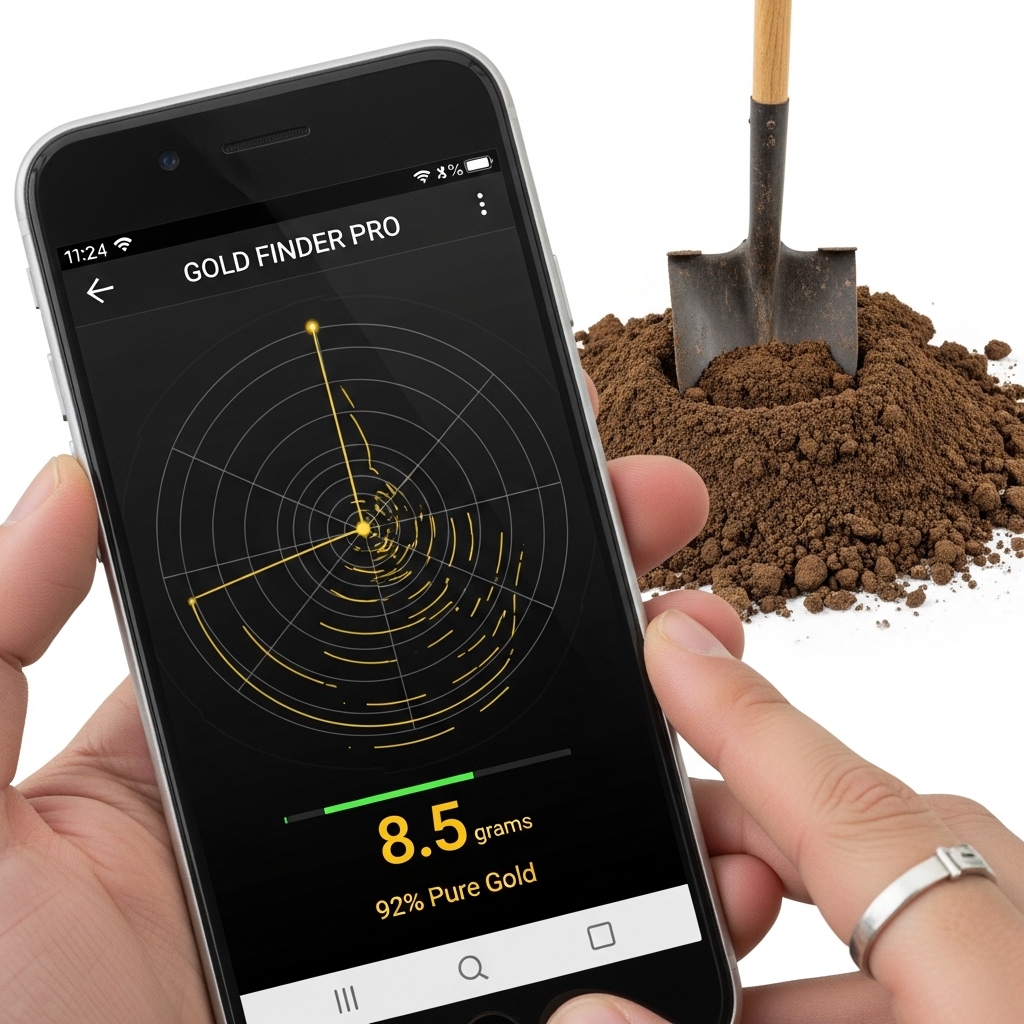
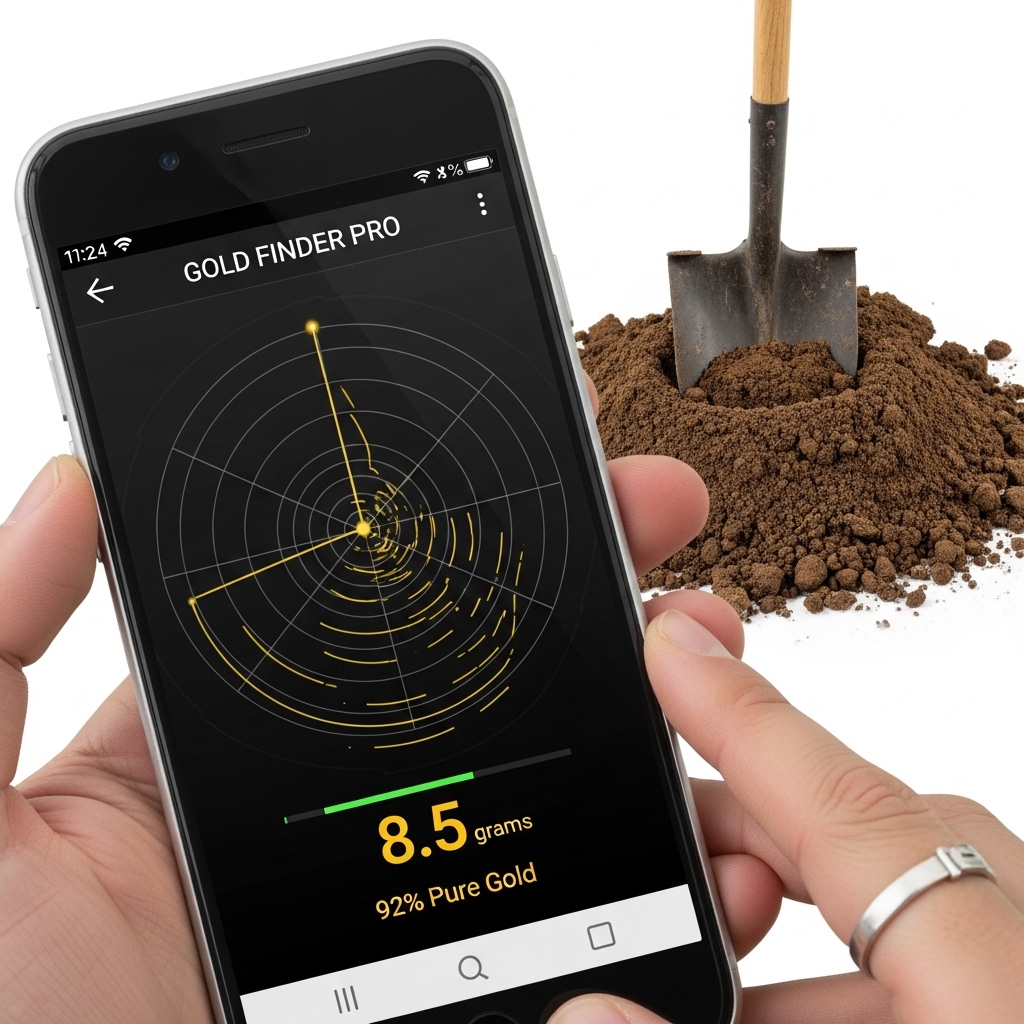
Looking for treasure has never been easier—modern smartphones now offer apps that claim to help detect gold and other metals right from your pocket.


Whether you’re a hobbyist metal detector enthusiast, a prospector, or simply curious about the technology, gold detection apps have sparked significant interest worldwide. These applications leverage the magnetic sensors built into most smartphones to identify metallic objects nearby.
Anúncios
While these apps won’t replace professional metal detectors, they offer a fascinating glimpse into how everyday technology can be repurposed for treasure hunting. Let’s explore how these apps work, their limitations, and whether they’re worth your time and effort. 🔍
📱 How Metal Detection Apps Actually Work
Modern smartphones come equipped with magnetometers—sensors originally designed to enable compass functionality. Metal detection apps tap into these sensors to measure magnetic field fluctuations in your environment.
Anúncios
When you bring your phone near a metallic object, the magnetic field around the device changes. The app detects this variation and alerts you through visual or audio signals. The stronger the magnetic field disturbance, the closer or larger the metal object likely is.
However, there’s an important caveat: not all metals are magnetic. Gold, silver, copper, and aluminum are non-ferrous metals with weak or negligible magnetic properties. These apps primarily detect ferrous metals like iron and steel.
This fundamental limitation means that while these apps can detect metal objects, they’re not specifically designed to find gold. The “gold detection” claim is often misleading marketing rather than technical reality.
⚡ The Technology Behind Your Phone’s Sensors
The magnetometer in your smartphone is a tiny, sophisticated piece of technology. It measures magnetic fields in three dimensions, providing accurate directional data for navigation apps.
This sensor operates by detecting the Earth’s magnetic field, which averages about 25 to 65 microteslas depending on your location. When a metal object disrupts this field, the magnetometer registers the change.
Most modern devices use Hall effect sensors or magnetoresistive sensors. These components are incredibly sensitive but were never intended for treasure hunting—their primary purpose is navigation and screen orientation.
The apps interpret these sensor readings and present them in user-friendly formats like meters, graphs, or numerical values. Some even include sound effects that increase in frequency as you approach metallic objects.
🏆 Popular Metal Detector Apps on the Market
Several apps claim to transform your smartphone into a metal detector. The most downloaded ones include Metal Detector by Smart Tools, Metal Detector PRO, and Ultimate EMF Detector.
These applications typically offer similar features: real-time magnetic field readings, calibration options, visual indicators, and sound alerts. The interfaces vary from simple numeric displays to complex graphical representations.
Metal Detector by Smart Tools has garnered millions of downloads and generally positive reviews. Users appreciate its straightforward interface and the ability to measure magnetic field strength in microteslas.
Most apps are free with ad support, while premium versions remove advertisements and may include additional features like historical data logging or enhanced sensitivity settings.
🔧 Key Features to Look For
When choosing a metal detector app, consider these essential features:
- Calibration capability: Allows you to zero out background magnetic interference
- Measurement units: Display in microteslas (µT) or milligauss (mG)
- Audio alerts: Sound changes based on metal proximity
- Sensitivity adjustment: Fine-tune detection range
- Data logging: Track readings over time
- Visual indicators: Graphs or meters showing field strength
💰 Can You Really Detect Gold With Your Phone?
This is the million-dollar question. Technically speaking, your smartphone cannot directly detect gold through magnetic field measurements because gold is non-magnetic.
Gold has a diamagnetic property, meaning it weakly repels magnetic fields. This effect is so subtle that smartphone magnetometers cannot reliably detect it, especially at any practical distance.
What these apps can potentially find are iron-rich minerals or ferrous objects that might be associated with gold deposits. In some geological contexts, magnetite or other magnetic minerals occur alongside gold ore.
Professional prospectors use sophisticated ground-penetrating radar, pulse induction detectors, and very low-frequency (VLF) equipment—technology far beyond smartphone capabilities.
If you’re serious about gold prospecting, invest in dedicated equipment. However, metal detector apps can be educational tools or fun gadgets for finding everyday metal objects like nails, pipes, or electrical wiring behind walls.
🌍 Practical Applications Beyond Gold Hunting
While these apps won’t make you rich finding gold nuggets, they have several legitimate practical uses that might surprise you.
Home improvement enthusiasts use them to locate studs, electrical wiring, or plumbing pipes behind walls before drilling. This can prevent costly mistakes and potential safety hazards.
Electricians and DIY hobbyists find them handy for tracing electrical circuits or confirming the presence of metal conduits. They’re not as accurate as dedicated stud finders but work in a pinch.
These apps can also detect hidden metal objects in furniture, check for authenticity of certain items, or even find lost jewelry in sand or soil—provided the jewelry contains ferrous metals.
🏠 Detecting Metals in Your Home
Your home contains numerous hidden metal objects: reinforcement bars in concrete, nails in wooden frames, pipes behind drywall, and electrical conduits. Metal detector apps can help you map these out.
Before hanging heavy items or drilling into walls, scan the area with your app. Sudden spikes in magnetic field readings indicate metal objects you should avoid.
This approach isn’t foolproof—non-ferrous pipes like copper or PVC won’t register—but it adds an extra layer of safety to home projects.
📊 Understanding Measurement and Accuracy
Metal detector apps typically display magnetic field strength in microteslas (µT) or milligauss (mG). The Earth’s natural magnetic field ranges from about 25 to 65 µT depending on your latitude.
When the app shows readings significantly higher than this baseline—say, 100 µT or more—you’re near a metallic object. The readings increase as you move closer to the metal source.
However, accuracy varies widely between devices. Sensor quality differs among smartphone manufacturers and models. Budget phones often have less sensitive magnetometers than flagship devices.
Environmental factors also affect readings. Electronic devices, power lines, and other sources of electromagnetic interference can create false positives or mask actual metal objects.
🎯 Calibration Tips for Better Results
Proper calibration significantly improves detection accuracy. Start by moving away from obvious metal objects and electronic devices.
Open your metal detector app and perform the calibration sequence—usually a figure-eight motion with your phone. This establishes a baseline for your current environment.
Repeat calibration whenever you change locations or notice inconsistent readings. Environmental magnetic fields vary by location, so what works in your living room won’t necessarily work in your garage.
⚠️ Limitations You Should Know About
Smartphone metal detectors have significant limitations that users should understand before expecting professional-grade results.
First, detection depth is minimal—typically just a few centimeters or inches. Professional metal detectors can sense objects buried much deeper, sometimes several feet underground.
Second, these apps cannot differentiate between metal types. A nail will trigger the same response as a gold ring (if the ring contains ferrous metals). There’s no material identification capability.
Third, battery drain can be considerable. Continuous sensor usage consumes power quickly, potentially leaving you with a dead phone during outdoor adventures.
Fourth, interference is common. Cars, buildings, power lines, and other phones all create electromagnetic noise that confuses the sensors.
🔬 The Science of Gold Detection
Understanding why gold is difficult to detect helps set realistic expectations. Gold is a noble metal with unique physical properties that make it chemically stable but magnetically inert.
Professional gold detectors use pulse induction (PI) or very low-frequency (VLF) technology. These systems generate their own electromagnetic fields and measure how objects disturb those fields.
PI detectors send powerful, brief pulses into the ground. When these pulses hit conductive materials like gold, they create tiny eddy currents that the detector senses.
VLF detectors operate on different frequencies, with some frequencies better suited for gold than others. Gold prospecting detectors typically operate at higher frequencies (18-70 kHz) to maximize sensitivity to small gold nuggets.
Your smartphone simply cannot generate or measure these specialized electromagnetic pulses. The magnetometer is a passive sensor designed for completely different purposes.
🎒 What Real Gold Prospectors Use
Serious gold hunters invest in specialized equipment ranging from hundreds to thousands of dollars. Entry-level VLF detectors start around $200-$300, while professional PI detectors can exceed $5,000.
Popular brands include Minelab, Garrett, Fisher, and Whites. Each offers models optimized for different conditions—beach hunting, gold prospecting, relic hunting, or general purpose use.
Beyond detectors, prospectors use gold pans, sluice boxes, classifiers, and magnifying loupes. Success requires knowledge of geology, historical research, and lots of patience.
Many prospectors also use GPS devices to mark promising locations, geological maps to identify potential gold-bearing formations, and specialized apps for claim research—but not for actual gold detection.
💡 Educational Value of Metal Detector Apps
While these apps won’t strike gold, they offer excellent educational opportunities, especially for students and curious minds interested in physics and technology.
They demonstrate electromagnetic principles in a hands-on, accessible way. Kids can learn about magnetic fields, sensor technology, and scientific measurement through experimentation.
Teachers can incorporate these apps into science lessons about magnetism, Earth’s magnetic field, or the properties of different materials. The immediate visual feedback makes abstract concepts tangible.
For amateur inventors and makers, understanding your phone’s sensors opens possibilities for creative projects and IoT applications.
🌟 Maximizing Your App Experience
If you decide to experiment with metal detector apps, follow these tips to get the most from the experience:
- Start with known metal objects to understand how your specific phone responds
- Test in different environments to learn what constitutes normal background readings
- Remove your phone case, as some cases contain magnetic elements that interfere with readings
- Move slowly and methodically when scanning—quick movements produce unreliable data
- Keep a log of interesting findings to track your learning progress
- Combine with visual inspection for better results
🚀 The Future of Mobile Detection Technology
Smartphone sensor technology continues advancing rapidly. Future devices may include more sophisticated sensors capable of detecting a wider range of materials and properties.
Researchers are developing new sensor types including terahertz scanners, advanced LIDAR, and enhanced spectrometers that could theoretically identify material composition through phone sensors.
Augmented reality integration could overlay detection data onto camera views, creating more intuitive treasure hunting experiences. Machine learning algorithms might improve signal processing and reduce false positives.
However, fundamental physics limitations mean smartphones will likely never match dedicated metal detectors for serious prospecting. The size, power, and design constraints of mobile devices create inherent compromises.
🎓 Learning Resources for Metal Detecting Enthusiasts
If metal detecting captures your interest, numerous resources can deepen your knowledge and skills:
Online communities like Reddit’s r/metaldetecting provide space for enthusiasts to share finds, ask questions, and learn from experienced hunters. YouTube channels dedicated to metal detecting offer tutorials and field demonstrations.
Local metal detecting clubs exist in many regions, offering group hunts, equipment advice, and mentorship opportunities. These clubs often have relationships with property owners who grant detecting permission.
Books about metal detecting, geology, and local history provide context that improves your understanding of where to search and what to expect in different environments.
🔐 Legal and Ethical Considerations
Before detecting anywhere, understand the legal landscape. Metal detecting is heavily regulated in many jurisdictions, with strict rules about where you can search and what you can keep.
National parks, archaeological sites, and most public lands prohibit metal detecting without permits. Private property requires explicit owner permission. Beaches may have specific regulations depending on local ordinances.
Found items may have legal owners or historical significance. Many regions have “treasure trove” laws governing the disposition of found valuables. Archaeological artifacts often legally belong to governments regardless of where they’re found.
Ethical detectorists follow a code of conduct: fill all holes, remove trash, respect property, report significant historical finds to authorities, and preserve sites for future generations.
🏁 Making an Informed Decision About Detection Apps
Metal detector apps represent an interesting intersection of consumer technology and specialized equipment. They’re free or inexpensive, always available in your pocket, and can be genuinely useful for specific applications.
However, they’re not miracle tools for finding gold or treasure. Understanding their capabilities and limitations prevents disappointment and helps you use them appropriately.
For casual curiosity, home improvement projects, or educational purposes, these apps deliver reasonable value. They won’t replace professional equipment but can complement it or serve as an introduction to the hobby.
If you develop a serious interest in metal detecting or gold prospecting, consider it a gateway rather than a destination. Learn the fundamentals, connect with experienced hunters, and gradually invest in proper equipment as your skills and commitment grow.
The real treasure isn’t necessarily gold coins or jewelry—it’s the knowledge gained, the outdoor adventures experienced, and the fascinating glimpses into history that metal detecting provides. Whether you use a smartphone app or a $3,000 professional detector, the journey itself holds the greatest value. ✨

Toni Santos is a visionary artisan and conceptual designer who channels the beauty of living organisms into structural expression. At Zureste, Toni explores the intricate elegance of insect anatomy, organic flow, and bioinspired design to create art that feels both natural and otherworldly.
Each creation Toni brings to life reflects a harmonic tension between structure and softness, wildness and control — echoing the complex intelligence found in the natural world. From beetle-like silhouettes to root-shaped contours, his work blurs the lines between biology, sculpture, and modern art.
Guided by fascination for metamorphosis, evolution, and pattern in nature, Toni’s pieces embody transformation. His BioLight Collection and conceptual series like Insect Type and Structure Aesthetics offer viewers more than aesthetic value — they present immersive experiences of living design.
As the creative force behind Zureste, Toni invites us to rethink beauty, architecture, and identity through a new lens — one shaped by wings, bones, spirals, and the microscopic poetry of the organic.
His creations reflect:
-
Design deeply rooted in the geometry of life
-
Inspiration from insects, roots, and the unseen natural order
-
A blend of science, spirituality, and visual storytelling
Whether you’re a lover of strange beauty, an admirer of evolution’s artistry, or a creative mind seeking something different, Toni welcomes you into a world where living forms become meaning, and surreal becomes sublime.